Just Plain Crazy, Or…
For years, I have joked with people that they probably think I am completely out of my mind for painting the things I do. But when I was actively working on my Out of Your Mind series between 2012 and 2015, the title carried a deliberate double meaning. The core idea wasn’t about me losing my sanity—it was the profound realization that the imagery in the artwork was supposed to be drawn out of the viewer’s mind. Long before I officially coined the term “Apofriendia,” this series was the visual sandbox where the philosophy was first born.
Where to Begin?
During that premier Out of Your Mind, 2012–2015 period, the core technique relied on smooth, texture-less canvases where paint was applied with brushes. Nothing unusual there. On the canvas a solid, mostly dark background became the sketchpad for highly fluid brushwork, using color, organic shapes and spontaneous outlining. Sometimes these intricate networks of lines remained isolated within the boundaries of the canvas; other times, they boldly rolled right over the edges of the gallery-wrap canvases. This pattern of painting I thought of as a conversation with the canvas. It was just how I came to work.
Say Hello!
I would make a mark, as if to say Hello, good morning! How are you? Then I’d react to how the color and brush stroke made me feel that I should do next. Much like after the initial hello, the other person replies, and now it’s your turn again… and so it goes, on and on. The conversation continues until both of us run out of things to say. During the back and forth, I am thinking, fully conscious and alert, but highly focused on the canvas. So much so that, were I to be listening to music and it stopped… I probably would not realize there was now silence. If someone were to walk into the studio and say something, I would probably jump, being startled out of my concentration. This is how ‘in the zone’ I became during painting sessions. Some of you already familiar with what this is like.
Do I see Sparks?
Pieces from this series, like Midnight of My Mind, Tipping Point, and Improbable Conceptions of Mother Goose On A Plate, perfectly captured this method. Perhaps the most complex painting from this chapter was my 2014 work, Up The Long Delirious Burning Blue. In all of these, the objective was not to tell you what I had painted (requiring you to see what I had painted as I saw it) but rather to let the fluid shapes and frequencies of color vibrations spark a viewer’s subconscious decoding system and get them to come into the sandbox and play a bit.
Who Am I?
As the years rolled on, my search for style continued to evolve. This era of my work I nicked-named The Years of Molasses. This period covered from around 2016 – 2024 when there were no ‘series’ being created. Rather, is was a time of the artist finding out what he has been doing as such. In those rough nine years that followed the Out of Your Mind series, I was experimenting and dimly beginning to understand how artwork can play with the subconscious.
Rorschach
It reminded me of the Rorschach inkblot test, and how that was used as a tool to delve into a subjects subconscious. I had been aware for the years I was painting Out of Your Mind that people would comment about seeing things in the artwork. All kinds of things. Dragons, angels, snakes, birds, fish, faces, figures, crowds… the list goes on. Where did they come from? I had not intentionally put them there. The most interesting thing, to me, was that, where one person would see ‘dark’ images, another person would see images of a brighter, happier nature. I began to wonder if the strange, fluid, non-defined images, were triggering responses inside the individual based on their own personal experiences?
Something Happening Here
Inside my abstract artwork there had always been chaos, but now I was seeing that the human mind, as it viewed the art, was trying to resolve the chaos into some kind of understandable order. I think the mind naturally tries to do this.
I have thought, here is a tool, as some might use – or a perhaps it’s a sandbox A place where the mind, the imagination can play.
For Example
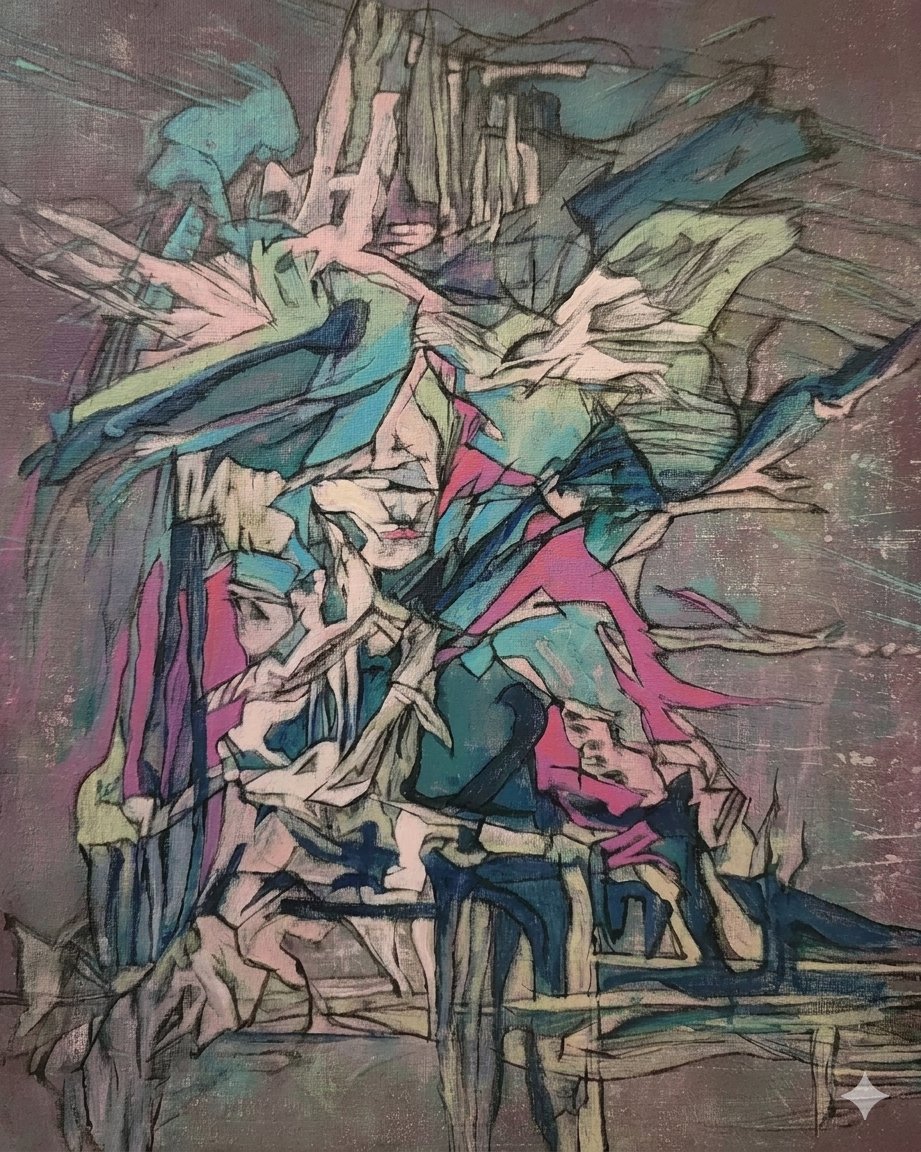
It was during this later Years of Molasses period that I painted More than Four (2021). When creating, I don’t always work on a painting in a single orientation. At some point I will begin to rotate the work in process and see it differently. I don’t know that this works for objective artwork but for abstract work this helps you “see” things that you didn’t know were there before. Even in the end, when you think you are done, it is hard to know how a dynamic composition should best hang on a wall. So when I finished the painting More than Four, I was totally baffled to find a title. As I physically rotated the canvas trying myself to play the viewer and capture a catchy title… I realized, it looked good every way I turned it! So, being unconvinced there was only one way to look at it, I just called it More than Four!
What I Saw
In the orientation I finally chose to display it for sale, my own imagination conjured a specific, fantastical image: an old, bent-over woman wearing one of those ridiculously adorned hats with things sticking out in every direction, seated on a bench—perhaps waiting for a bus. I loved it that way, but because the painting held three other distinct lives when flipped, I still held to that More than Four title. Though I relate my viewer’s experience do not let this restrict you own minds ability to create your own story for the painting. That is the final and necessary aspect of the apofriendia experience. You begin your own conversation with the artwork.
The Long View
I will declare that every painting has not always been a good (or even an) apofriendia representation (I have broken the thread with representational works), but, for the most part, though separated by years, shifting techniques, through good and bad experimentation, the thread between my 2012 canvases and my work right up to today is unbroken. The forms are left fluid, rhythmic, and intentionally unresolved. They are inviting your subconscious to take the wheel. You don’t have to guess what I was thinking when I stood at the easel; you simply have to take a step into the sandbox and discover what your own mind draws out of the painting.
Dave